For our second
extract from Oz Clarke's new book, The History of Wine in 100 Bottles,
read about the birth of claret, dating back to the 12th century.

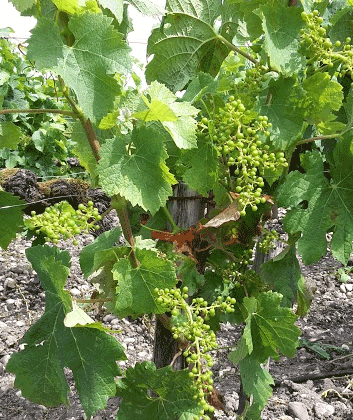
Chateau Pape Clement


So often in our history, it’s politics, not taste, that decides
what our favourite tipple is going to be. One of our lot marries the
King of Spain’s daughter, so suddenly we’re all drinking sherry. A Dutch
prince suddenly turns up on the English throne, so suddenly we’re all
drinking gin. And it’s the same with Bordeaux and its wine, which for
hundreds of years became known as the Englishman’s drink – claret, or
the light red wine of Bordeaux.
Bordeaux
had been settled by the Romans, but not with the objective of planting
vineyards. It was because the Gironde estuary with Bordeaux at its bend
is the biggest natural harbour in western Europe. A perfect place for a
trading post, because if you look at a map the best shortcut between the
Mediterranean and the sea routes to the markets of northern Europe is
across southwest France from Narbonne to Bordeaux. The Romans did plant
vines – particularly around Blaye, Bourg and Saint-Émilion on the right
side of the Gironde – but when their empire collapsed, Bordeaux’s trade
went with it. By the Middle Ages, the young port of La Rochelle to the
north was far more prosperous, initially for its salt exports, but
pretty quickly for its wine too. Again, it wasn’t that the wine was
good, but that the ships needed filling. Trade not taste.
In 1151, Henry Plantagenet, the future Henry II of England, married
Eleanor of Aquitaine – and with her came the massive dowry of Aquitaine.
The kingdom of France didn’t cover all of modern France in those days,
and Aquitaine was a powerful independent dukedom covering the whole of
southwest France, including La Rochelle and Bordeaux. Aquitaine now
became English.
La Rochelle
continued to prosper until the King of France attacked Aquitaine; La
Rochelle surrendered, while Bordeaux pledged eternal loyalty to the
English crown, and from then on a deep, special relationship developed
between Bordeaux and England, with wine at its heart. To be honest, the
local Bordeaux wines were a bit insipid and needed beefing up with wines
from places like Cahors and Gaillac inland, but by the 14th century
Bordeaux merchants – an increasing number of them British – were
shipping casks equivalent to 110 million bottles of wine from the quays
of Bordeaux each year.
Vines were planted all round the city walls and particularly in the
Graves, though not in the Médoc to the north, which would eventually
become Bordeaux’s most famous region – but until the Dutch drained it in
the 17th century it was a swamp. Great convoys of 200 or more ships at a
time would arrive in Bordeaux each autumn and each spring to load up
with Bordeaux ‘claret’ and head for English and Scottish ports such as
Bristol, London, Leith and Dumbarton. By the 14th century some estimates
reckon Bordeaux was sending Britain enough wine for every man, woman
and child to have six bottles each. Bliss.
But it couldn’t last. France wanted Aquitaine back. England wanted to
keep it, and in 1337 the Hundred Years’ War broke out. It ended in 1453
with Sir John Talbot of the English side being defeated at the Battle
of Castillon. Some said he’d had too much to drink for lunch. No matter.
The British taste for Bordeaux red wines was established, and remains
to this day.
This extract was taken from
The History of Wine in 100 Bottles by Oz Clarke.
#Bordeaux #Claret #OzClarke