Translate

Search This Blog

Thursday, July 23, 2015

The Birth of Claret


For our second extract from Oz Clarke's new book, The History of Wine in 100 Bottles, read about the birth of claret, dating back to the 12th century.
Claret 1645Chateau TalbotSo often in our history, it’s politics, not taste, that decides what our favourite tipple is going to be. One of our lot marries the King of Spain’s daughter, so suddenly we’re all drinking sherry. A Dutch prince suddenly turns up on the English throne, so suddenly we’re all drinking gin. And it’s the same with Bordeaux and its wine, which for hundreds of years became known as the Englishman’s drink – claret, or the light red wine of Bordeaux.

Bordeaux had been settled by the Romans, but not with the objective of planting vineyards. It was because the Gironde estuary with Bordeaux at its bend is the biggest natural harbour in western Europe. A perfect place for a trading post, because if you look at a map the best shortcut between the Mediterranean and the sea routes to the markets of northern Europe is across southwest France from Narbonne to Bordeaux. The Romans did plant vines – particularly around Blaye, Bourg and Saint-Émilion on the right side of the Gironde – but when their empire collapsed, Bordeaux’s trade went with it. By the Middle Ages, the young port of La Rochelle to the north was far more prosperous, initially for its salt exports, but pretty quickly for its wine too. Again, it wasn’t that the wine was good, but that the ships needed filling. Trade not taste. In 1151, Henry Plantagenet, the future Henry II of England, married Eleanor of Aquitaine – and with her came the massive dowry of Aquitaine. The kingdom of France didn’t cover all of modern France in those days, and Aquitaine was a powerful independent dukedom covering the whole of southwest France, including La Rochelle and Bordeaux. Aquitaine now became English.

La Rochelle continued to prosper until the King of France attacked Aquitaine; La Rochelle surrendered, while Bordeaux pledged eternal loyalty to the English crown, and from then on a deep, special relationship developed between Bordeaux and England, with wine at its heart. To be honest, the local Bordeaux wines were a bit insipid and needed beefing up with wines from places like Cahors and Gaillac inland, but by the 14th century Bordeaux merchants – an increasing number of them British – were shipping casks equivalent to 110 million bottles of wine from the quays of Bordeaux each year. Vines were planted all round the city walls and particularly in the Graves, though not in the Médoc to the north, which would eventually become Bordeaux’s most famous region – but until the Dutch drained it in the 17th century it was a swamp. Great convoys of 200 or more ships at a time would arrive in Bordeaux each autumn and each spring to load up with Bordeaux ‘claret’ and head for English and Scottish ports such as Bristol, London, Leith and Dumbarton. By the 14th century some estimates reckon Bordeaux was sending Britain enough wine for every man, woman and child to have six bottles each. Bliss.
But it couldn’t last. France wanted Aquitaine back. England wanted to keep it, and in 1337 the Hundred Years’ War broke out. It ended in 1453 with Sir John Talbot of the English side being defeated at the Battle of Castillon. Some said he’d had too much to drink for lunch. No matter. The British taste for Bordeaux red wines was established, and remains to this day.

This extract was taken from The History of Wine in 100 Bottles by Oz Clarke.

#Bordeaux #Claret #OzClarke

Friday, July 3, 2015

A Beautiful Evening at Cantemerle during Vinexpo


After a hectic day at Vinexpo, a chilled glass of Champagne in the shade was pure heaven.  Thank you to the organizers for providing such a varied and light buffet instead of a heavy meal and the wonderful vertical tasting!

#Cantemerle #Vinexpo

I think I prefer visiting wineries the old fashioned way!

Virtual visitors to California can now take a panoramic tour of dozens of the state’s wineries thanks to new additions to the Street View feature in Google Maps.
The internet giant has added 360-degree panoramas of nearly 80 of California’s 1,000-plus wineries as part of an initiative that has extended Street View to more than 200 new locations across the state.
Via a ‘See Inside’ tab, internet surfers can now enter the premises of a number of leading producers, including Dry Creek Vineyard, Frog’s Leap, Schramsberg and Artesa.

Read more at http://www.decanter.com/wine-news/google-street-view-offers-virtual-tours-of-california-wineries-265643/#pVbHqupQdGKgSlIg.99

Bordeaux Vintage 2015 is looking good!

Chateau owners in Medoc say the Bordeaux 2015 vintage has got off to a good start following excellent flowering conditions in the vineyard, despite some concerns over recent rain.
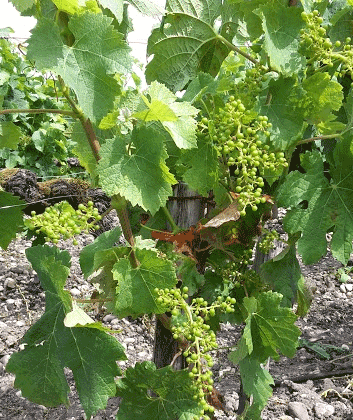
Image: Chateau Margaux vines.
The flowering period of the Bordeaux 2015 growing season has put chateaux owners in an optimistic mood, with several describing conditions as ‘perfect’.
‘There is still a long way to go, but we have nice, big bunches and that means there is good potential for quantity,’ said Philippe Dhalluin, of first growth Chateau Mouton Rothschild in Pauillac.
The character and quality of the Bordeaux 2015 vintage can still be determined in the next three months. There have already been concerns about rot in some vineyards due to recent bouts of rain.
In 2014, the growing season got off to an early start but was pinned back by a cold, damp August – only to be rescued by the hottest September in Bordeaux for decades.
At Chateau du Tertre and Chateau Giscours, director Alexander Van Beek said he was particularly impressed with the Merlot flowering period. ‘We haven’t seen this with Merlot for years,’ he told Decanter.com.

Read more at http://www.decanter.com/bordeaux-wines/bordeaux-news-bordeaux-wines-3/bordeaux-2015-medoc-chateaux-dare-to-dream-after-perfect-flowering-263703/#G3mxQBjzq1bt0s4r.99

Lix-ex Fine Wine 100 Index grows after years of decline


Fine wine prices are staging a ‘gentle’ recovery after four years of decline – despite a Bordeaux en primeur campaign described as ‘lacklustre’.
Fine wine market Liv-ex said its Fine Wine 100 Index rose 0.9% in June to close on 244.08, up 3.4% on a year ago.
That follows a slow recovery from the nadir of July last year, when the index dropped to 234.01, its lowest level since September 2009. It rose 1.9% to the end of 2014 and has gained 2.3% in 2015 so far.
Bordeaux Index MD Gary Boom said the market was experiencing ‘welcome, gentle recovery’, with the company’s own LiveTrade index up 3.02% in 2015 and rising steadily every month since last August.
‘This gentle growth is welcome as many of our customers who watch the market carefully are no longer dissuaded from making their trades,’ he added. ‘In a falling market they will delay their purchases and understandably so.’
Nonetheless, both Boom and Liv-ex director Justin Gibbs remain cautious about the definitive nature of any recovery.
Describing the market as ‘by no means easy’, Boom said: ‘We are having to work hard for every sale and, aside from around 10 wines that sold very well, either on quality or price or both, the 2014 [en primeur] campaign did not help us very much.
‘That said, if the final feeling from the consumer about the 2014 campaign is one of indifference, then that is a considerably better situation than in the past couple of years, where there was real dissatisfaction with Bordeaux.’
Gibbs said: ‘Despite a lacklustre en primeur campaign, the secondary market has held up very well.
‘After four years of declines, few are prepared to call the turn, but our internal indicators suggest that a long overdue recovery may be under way.’

Read more at http://www.decanter.com/wine-news/lix-ex-fine-wine-100-index-grows-after-years-of-decline-265438/#iiekGV7fpRYESmIG.99

Liqueur tasting in Barcelona

Four versions of the same liqueur - delicious!


We love Spanish Wine!

Although the glasses left a bit to be desired, the wine was delicious!  From the stable of Pesquera.


#SpanishWines #Pesquera